
SPF fail explained: causes, types, and fixes

TL;DR:An SPF fail occurs when the sender’s IP address is not listed in the domain’s SPF record, risking email spoofing. Without DKIM and DMARC, SPF failures alone do not reliably prevent impersonation or ensure message safety. Sealedmail offers weekly expert-reviewed reports to monitor and address SPF issues proactively, supporting compliance and improving deliverability.
What does SPF fail mean for your email authentication?
An SPF fail occurs when the IP address sending an email is not listed as an authorised sender in the domain’s SPF DNS record. The Sender Policy Framework (SPF) works by letting domain owners publish a list of approved sending servers in DNS. When a receiving mail server checks an inbound message, it compares the sending IP against that list. If there is no match, the result is a failure.
SPF sits alongside DKIM and DMARC as part of a three-layer email authentication framework. On its own, SPF alone does not prevent spoofing. It designates authorised sending IPs, but without DKIM and DMARC working alongside it, a failure result cannot reliably distinguish a fraudulent message from a legitimate one that simply was not configured correctly.
Common symptoms and triggers of SPF failure include:
- Emails landing in recipients’ spam folders without explanation
- Bounce messages referencing authentication errors
- DMARC aggregate reports showing a high proportion of failing messages
- Forwarded emails failing SPF checks at the destination server
- New third-party sending services not yet added to the SPF record
Pro Tip: When you see an SPF failure in a DMARC report, check whether DKIM passed on the same message. If DKIM passed and is aligned, DMARC can still pass even when SPF fails, so the delivery impact may be smaller than it first appears.
Table of Contents
- Common causes of SPF failure and validation errors
- What the different SPF failure results actually mean
- How SPF failure affects email deliverability and security
- How to troubleshoot and fix SPF failures
- How Sealedmail helps you manage SPF failures proactively
- SPF fail scenarios in UK organisations
- Why Sealedmail is the clearest path to SPF failure prevention
- Key takeaways
- FAQ
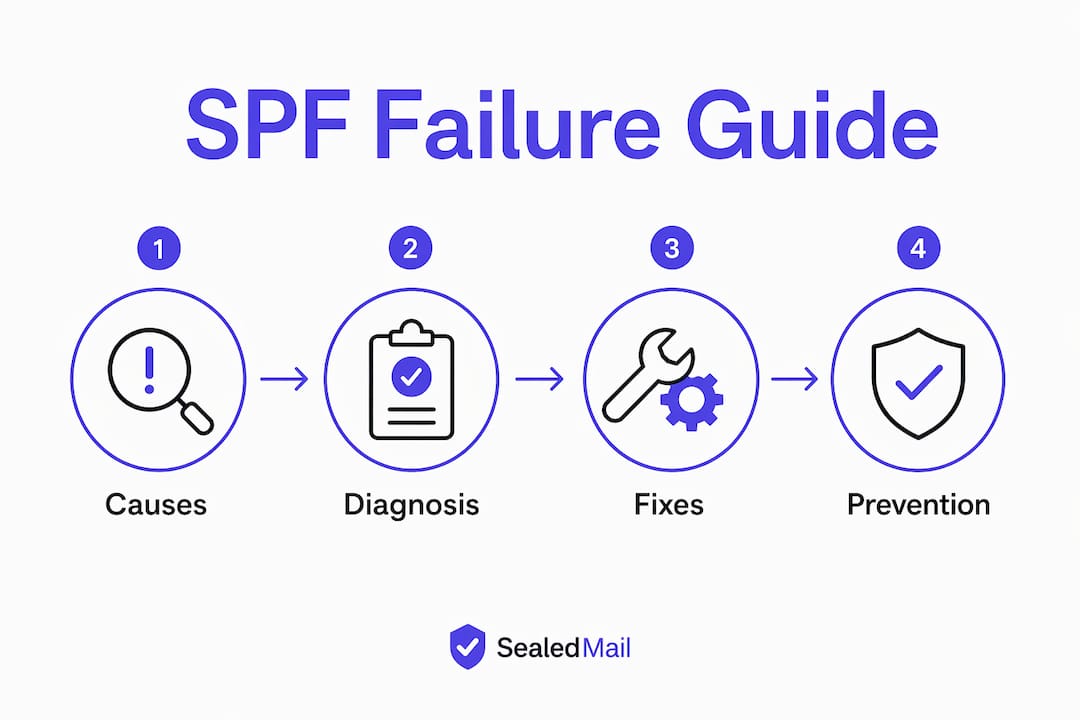
Common causes of SPF failure and validation errors
Most SPF failures trace back to a small set of configuration mistakes. Knowing which one applies to your domain cuts diagnosis time considerably.
- Multiple SPF TXT records: Only one SPF record is permitted per domain. Multiple records cause an immediate permerror, breaking authentication for every message the domain sends.
- Exceeding the 10 DNS lookup limit: Each
include,a,mx,ptr, andredirectmechanism in an SPF record counts as a DNS lookup. The SPF specification caps these at 10 per evaluation. Going over that limit produces a permerror. - Missing authorised senders: Adding a new CRM platform, marketing tool, or third-party relay without updating the SPF record is one of the most common causes of SPF authentication errors. The new service sends from IPs the record does not recognise.
- Syntax errors: A missing
v=spf1tag, a typo in a mechanism, or an incorrect qualifier will cause the record to fail validation entirely. - Forwarding: When a recipient forwards an email, the forwarding server’s IP is almost never in the original sender’s SPF record. This is an inherent limitation of SPF, not a configuration mistake.
| Cause | Symptom | Recommended fix |
|---|---|---|
| Multiple SPF records | permerror on all messages | Merge into a single TXT record |
| Over 10 DNS lookups | permerror on all messages | Flatten record using ip4/ip6 mechanisms |
| Missing sender | softfail or fail for that sender | Add include: for the third-party service |
| Syntax error | permerror or none result | Validate record with an SPF lookup tool |
| Email forwarding | fail on forwarded messages | Implement DKIM and configure ARC sealers |
| Low TTL | Intermittent temperror | Set TTL to at least 3,600 seconds |
Pro Tip: Use MXToolbox’s SPF lookup to count your DNS lookups before and after any record change. It is the fastest way to catch a lookup limit breach before it reaches production.
What the different SPF failure results actually mean
SPF does not return a simple pass or fail. There are five distinct failure results, and each one tells you something different about what went wrong.
- None: No SPF record exists for the sending domain. The receiving server found nothing to evaluate. This is common on newly registered domains or subdomains that have never had SPF configured.
- Softfail (~all): The sending IP is not authorised, but the domain owner has not issued a hard rejection. The
~allqualifier signals that the message is suspicious but should not be outright rejected. Most receiving servers will deliver it, often with a spam score penalty. - Hardfail (fail, -all): The sending IP is explicitly not authorised. The
-allqualifier is a definitive statement that the message should be rejected. Some receiving servers act on this immediately; others defer to DMARC policy before deciding. - Permerror: A permanent error caused by a misconfigured record, typically exceeding the DNS lookup limit or having multiple SPF records. This result invalidates SPF authentication for every message from the domain until the record is corrected.
- Temperror: A temporary DNS failure, usually because the authoritative DNS server was unreachable or timed out during the lookup. The receiving server may retry or defer the message.
The distinction between softfail and hardfail matters most when DMARC is not yet in place. Without DMARC, a hardfail can cause legitimate forwarded emails to be rejected outright, with no fallback mechanism to save them.
How SPF failure affects email deliverability and security
An SPF failure does not automatically mean a message is rejected. What happens next depends on the receiving server’s configuration and whether DMARC is present.

SPF failures commonly cause emails to be delivered to spam rather than rejected outright, particularly when the failure is a softfail. Some servers reject hardfail results at the SMTP level, before the message body is even accepted. Others pass the message through to DMARC evaluation, where a DKIM pass can rescue it. The practical outcome varies considerably between receiving environments.
The security risk is more consistent. A domain without a correctly configured SPF record is easier to spoof. Fraudsters can send phishing emails that appear to come from your domain, and without SPF, DKIM, and DMARC all working together, receiving servers have no reliable way to detect the forgery. For UK organisations in regulated sectors, this is not a theoretical risk. Business email compromise frequently exploits exactly this gap.
SPF inherently fails on forwarded mail because the forwarding server’s IP is not in the original sender’s record. DKIM signatures survive forwarding intact, which is why DKIM is the more reliable authentication layer for forwarded messages. This is one reason why running SPF without DKIM leaves you exposed.
Pro Tip: Many IT administrators assume that setting -all (hardfail) gives them the strongest protection. In practice, it can cause legitimate forwarded emails to be rejected before DMARC has a chance to evaluate DKIM. Using ~all (softfail) alongside a DMARC policy of p=reject gives you the same enforcement outcome with far fewer false rejections.
How to troubleshoot and fix SPF failures
Diagnosing an SPF failure follows a logical sequence. Work through these steps before making any changes to your DNS.
- Confirm you have exactly one SPF record. Query your domain’s TXT records using
dig TXT yourdomain.comor an online lookup tool. If you see two lines beginning withv=spf1, merge them immediately. - Count your DNS lookups. Each
include:,a,mx,ptr, andredirectmechanism adds to your lookup count. The 10-lookup limit is a hard ceiling. Flatten the record by replacinginclude:statements with explicitip4:orip6:entries where possible. - Audit your sending sources. List every service that sends email on behalf of your domain: your mail server, CRM, marketing platform, helpdesk tool, and any transactional email provider. Each one needs an
include:or IP entry in the record. - Check syntax carefully. The record must begin with
v=spf1and end with a qualifier (~all,-all, or?all). A missing space, a duplicated mechanism, or a misspelled domain in aninclude:will break the record. - Review DNS propagation timing. After any change, allow time for propagation. Setting your SPF record’s TTL to at least 3,600 seconds reduces the risk of intermittent lookup failures during propagation windows.
- Use diagnostic tools. MXToolbox SPF lookup, Google Admin Toolbox, and the
nslookupcommand all help you verify what the world sees when it queries your record. - Check DMARC aggregate reports. DMARC reports show you which IPs are sending on your domain’s behalf and whether they pass or fail SPF. This is often the fastest way to identify a missing sender.
For teams managing complex email environments across multiple clients or domains, a structured audit process for each domain’s SPF record prevents failures from accumulating unnoticed.
Pro Tip: During any SPF rollout or major record change, switch to ~all (softfail) temporarily. This prevents legitimate mail from being rejected while you confirm all sending sources are correctly listed. Once you have verified coverage through DMARC reports, tighten to -all if your policy requires it.
How Sealedmail helps you manage SPF failures proactively
Reactive troubleshooting only gets you so far. By the time an SPF failure surfaces in a bounce report or a user complaint, the damage to deliverability or domain reputation may already be done. Proactive monitoring changes that dynamic entirely.
Sealedmail provides weekly reports covering DMARC, SPF, DKIM, TLS-RPT, MTA-STS, blacklist status, and BIMI health for your domain. Each report is reviewed by an expert before it reaches you, written in plain English rather than raw aggregate data. That distinction matters in practice: a raw DMARC XML report can show hundreds of IP addresses sending on your domain’s behalf, and without interpretation, it is difficult to tell which failures are spoofing attempts and which are legitimate services that simply need adding to your SPF record.
Sealedmail’s service is built specifically for sectors where email security carries regulatory weight, including law firms, financial services, healthcare, accountants, and charities. For NHS and healthcare organisations, SPF monitoring feeds directly into DSPT compliance evidence. For financial services firms, it supports FCA-aligned audit trails.
Key features of Sealedmail’s monitoring service:
- Weekly expert-reviewed reports on SPF, DKIM, DMARC, and related authentication metrics
- Plain-English summaries that identify failures, their likely causes, and recommended actions
- Compliance-ready audit evidence for regulatory frameworks
- Blacklist monitoring to catch domain reputation issues before they affect delivery
- A free initial domain health check with no dashboards or jargon
The service is priced for organisations that need expert oversight without the overhead of a dedicated in-house email security function.
SPF fail scenarios in UK organisations
SPF failures in UK organisations tend to follow recognisable patterns, and the consequences vary depending on how quickly they are caught.

A common scenario involves a UK professional services firm that adds a new marketing automation platform without updating its SPF record. The platform sends campaign emails from its own IP ranges, which are not listed in the firm’s record. Recipients using strict DMARC policies begin rejecting or quarantining those messages. The firm notices a drop in campaign open rates weeks later, by which point the platform has been sending unauthenticated email for an entire campaign cycle.
A second pattern appears frequently in NHS trusts and healthcare organisations. A trust’s IT team updates its email infrastructure, moving to a cloud-hosted mail platform. The old SPF record still references the on-premises server’s IP ranges. The new platform’s IPs are not included. Outbound clinical communications begin failing SPF checks at recipient domains that enforce DMARC. The failure is invisible to the sending side until a DMARC aggregate report surfaces it, often days later.
Forwarding is a third source of SPF failures that catches UK organisations off guard. A law firm’s client forwards a message from the firm’s domain to a colleague at another organisation. The forwarding server’s IP is not in the firm’s SPF record, so the forwarded message fails SPF at the destination. If the firm has not implemented DKIM, there is no fallback authentication to preserve deliverability. The colleague’s server may quarantine or reject the message entirely.
Each of these scenarios shares a common thread: the failure was preventable with routine monitoring and a complete audit of sending sources. DMARC monitoring provides the visibility to catch these issues before they affect real communications.
Why Sealedmail is the clearest path to SPF failure prevention
SPF failures are rarely a one-time fix. New sending services get added, DNS records drift, and third-party providers change their IP ranges without warning. Keeping on top of all of that alongside your other responsibilities is where most IT teams lose ground.
Sealedmail takes the monitoring burden off your plate. You get weekly expert-reviewed reports that tell you exactly what is passing, what is failing, and why, in plain English. There are no dashboards to learn, no raw XML to parse, and no guesswork about whether a failure is a spoofing attempt or a misconfigured include. A single expert reviews your DMARC data personally and delivers findings you can act on immediately.
For regulated sectors, the service also produces compliance-ready audit evidence, which means your SPF and DMARC health is documented and defensible when regulators or auditors ask. Whether you manage email for a law firm, an NHS trust, a charity, or a financial services business, Sealedmail gives you the oversight that reactive troubleshooting cannot.
Start with a free domain health check at sealedmail.co.uk/dmarc-monitoring and see exactly where your authentication stands today.
Key takeaways
An SPF fail means the sending IP is not authorised in the domain’s SPF record, and without DKIM and DMARC working alongside it, that failure can directly harm deliverability and leave your domain open to spoofing.
| Point | Details |
|---|---|
| SPF fail defined | The sending IP does not match any authorised entry in the domain’s SPF DNS record. |
| Permerror is the worst outcome | Exceeding 10 DNS lookups or having multiple SPF records breaks authentication for every message from the domain. |
| Softfail beats hardfail during rollout | Using ~all prevents legitimate mail rejection while you verify all sending sources via DMARC reports. |
| DKIM is the essential companion | SPF fails on forwarded mail by design; DKIM signatures survive forwarding and provide the fallback authentication layer. |
| Sealedmail monitors continuously | Weekly expert-reviewed reports at £39 per domain per month identify SPF failures, their causes, and recommended fixes in plain English. |
FAQ
Why is SPF failing on my domain?
The most common reasons are a missing authorised sender in the SPF record, exceeding the 10 DNS lookup limit, or having multiple SPF TXT records published for the same domain. Use an SPF lookup tool to identify which condition applies.
When does an SPF hard fail occur?
A hard fail occurs when the sending IP does not match any mechanism in the SPF record and the record ends with -all. The -all qualifier is an explicit instruction to reject the message, as defined in RFC 7208.
What causes an SPF soft fail?
An SPF soft fail results when the sending IP is not listed in the record but the domain uses ~all rather than -all. The message is flagged as suspicious but not outright rejected, giving DMARC and DKIM the opportunity to influence the final delivery decision.
How do I fix an SPF validation error?
Confirm you have a single SPF TXT record, count your DNS lookups to stay under 10, add any missing third-party senders using include: statements, and validate the syntax with a tool such as MXToolbox. Set your record’s TTL to at least 3,600 seconds to avoid propagation-related temperrors.
Does Sealedmail help with ongoing SPF failures?
Yes. Sealedmail’s weekly reports cover SPF alongside DMARC and DKIM, identifying which IPs are failing authentication and whether those failures represent spoofing or a legitimate sender that needs adding to your record. The service is available at £39 per domain per month with a free initial domain health check.
Recommended

Founder of SealedMail and a UK email-security specialist in DMARC, SPF, DKIM and email authentication for regulated sectors. He personally reads the DMARC and TLS reports behind every SealedMail account and writes the company's plain-English guides. More from Shaun Cooke →
