
Top 6 Email Security Checker Alternatives 2026

Managing email authentication and domain compliance remains complex for IT and security teams wanting actionable monitoring. Many traditional email security checkers restrict features to single domains or lack automated reporting needed for large estates. This comparison shows feature scope, reporting clarity, and automation across six DMARC monitoring platforms so IT and security teams can match software to domain volume and approach.
Table of Contents
SealedMail
At a Glance
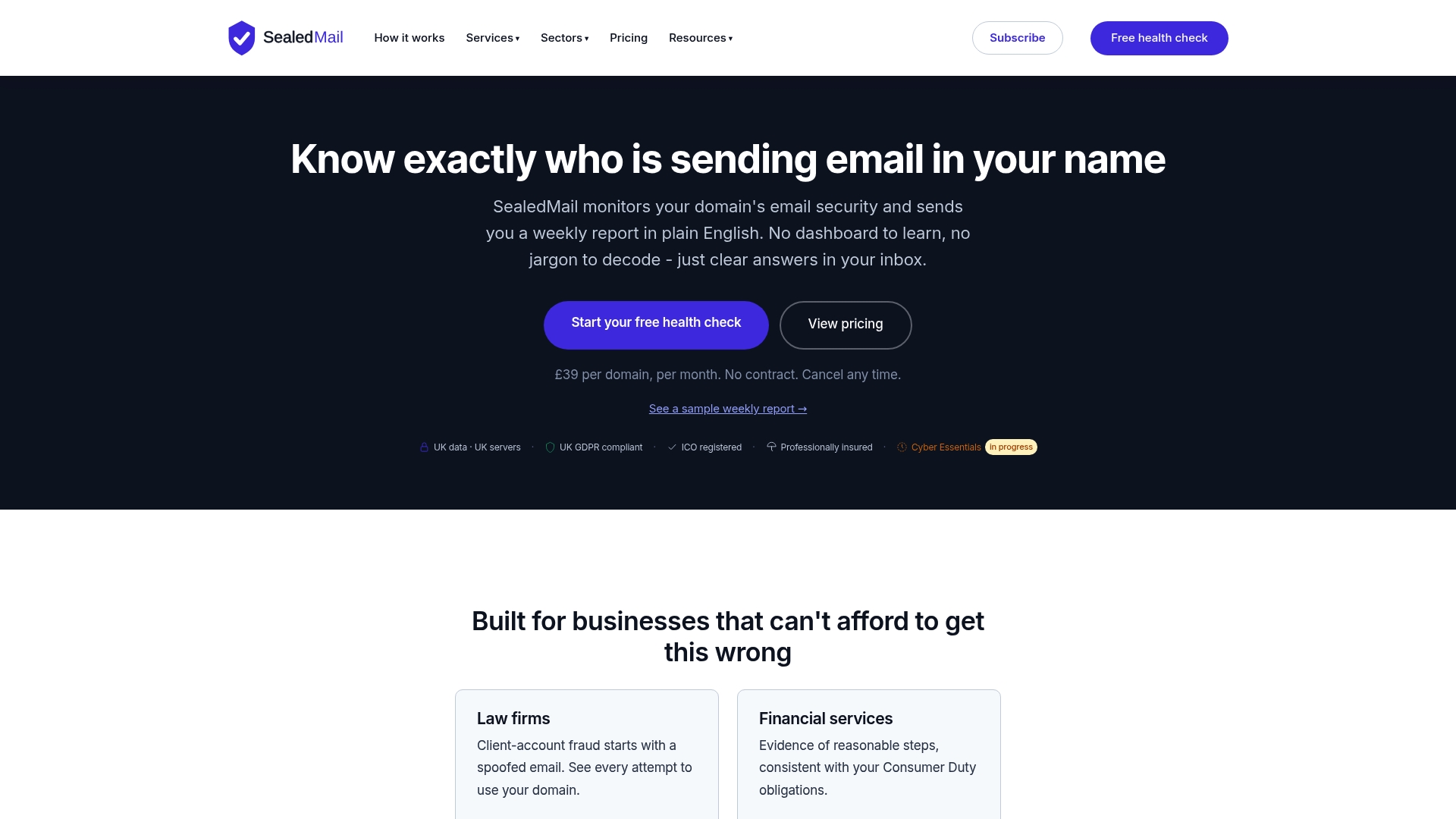
£39 per domain per month buys weekly plain English DMARC reports delivered by email. The reports are written and reviewed by a single UK based email security specialist, Shaun Cooke. The service targets law firms, financial services, healthcare, accountants, and charities and requires no new software or technical skills.
Core Features
SealedMail sends a weekly plain English DMARC report that highlights spoofing and unauthorised senders and shows authentication health. The service checks SPF, DKIM, DMARC, and MTA STS and maintains an always live DNS status page. DNS record updates remain the responsibility of the user or their DNS provider while SealedMail explains what to change.
Key Differentiator
Personalised UK based email security reporting written and managed by an industry specialist sets SealedMail apart. Each weekly report receives human review so the output is tailored rather than machine summarised. That approach reduces technical jargon and produces evidence that can be shown during audits.
Pros
Reports are simple and readable so non technical staff can act on them. The vendor states the service is GDPR compliant and keeps data on UK servers. Personalised support comes from a named expert who reviews your DMARC data weekly. There are no setup fees, no contracts, and the price is a fixed monthly figure per domain.
Cons
- No real time alerts or live dashboard. Reports are delivered weekly only.
Who It’s For
UK businesses that send email from their own domains and want plain English compliance and security reports will benefit most. Small law firms and accountants that need audit evidence but not in house DNS expertise fit particularly well. Organisations that require hands on DNS remediation will find the model less suitable.
Unique Value Proposition
£39 per domain per month makes an expert reviewed weekly report an affordable way to demonstrate due diligence. That price point shifts the work from technical staff to a single specialist who explains what the reports mean. The model reduces the need for internal expertise while creating a clear audit trail.
Real World Use Case
A small law firm subscribes and receives weekly reports that highlight which senders are authorised on their domain. The partner prints the reports for archive and shows them during client and regulator audits. The firm avoids chasing technical detail because the report says what the DNS changes should be.
Pricing
Pricing starts at £39 per domain, per month. The vendor offers discounts for annual subscriptions and states there is no VAT.
Website: https://sealedmail.co.uk
PowerDMARC
At a Glance
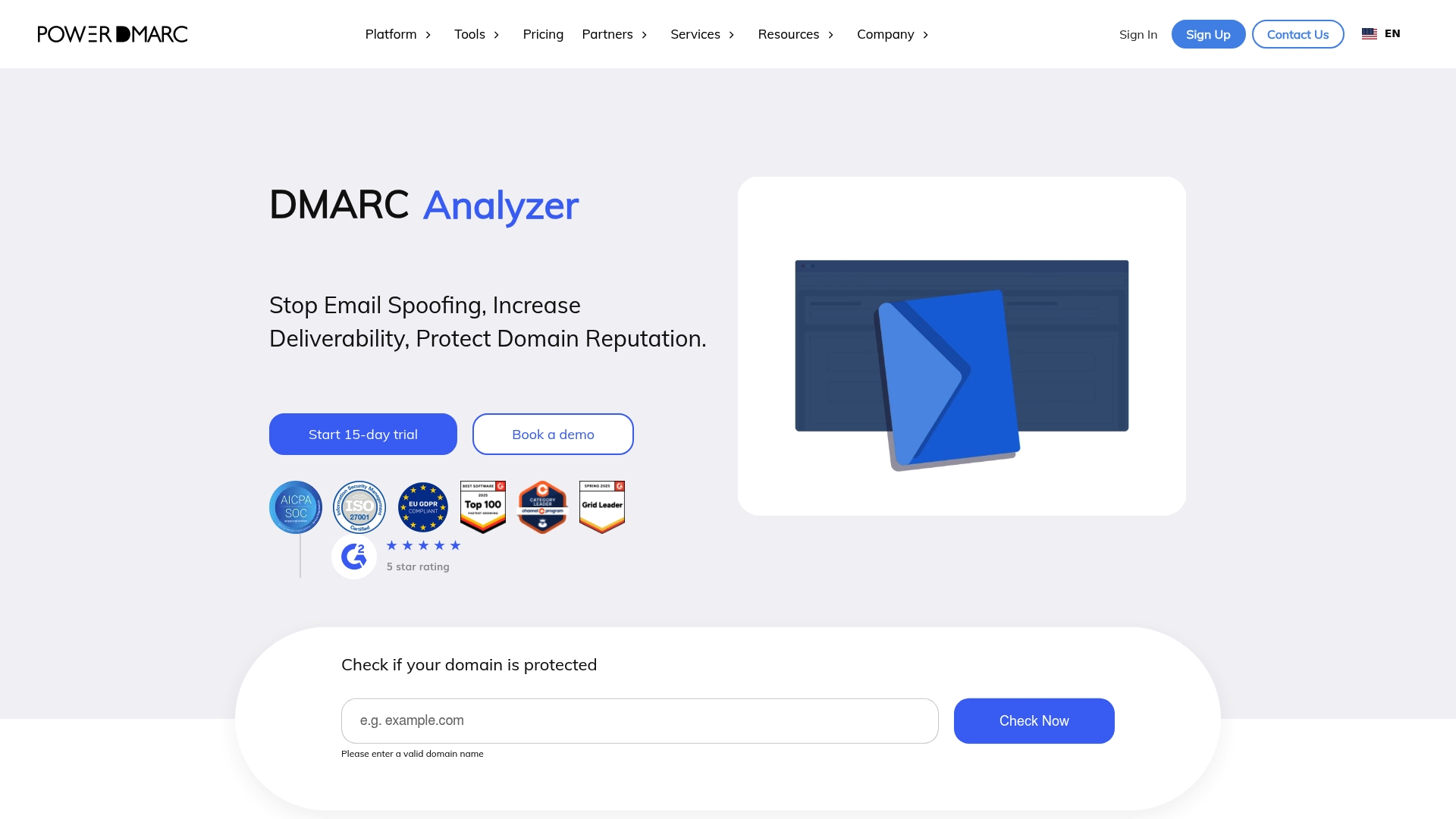
PowerDMARC includes a built in multi tenant MSP partner programme with white label options and automation for managing many client domains. The vendor says the platform combines reporting, DNS management, and threat intelligence in a single pane. That mix makes it attractive to managed service providers and large IT teams seeking centralised control. The interface places reporting and DNS tasks within reach of administrators who manage dozens of domains.
Core Features
PowerDMARC delivers DMARC aggregate and forensic reporting alongside email header and domain reputation analysis. It offers a live threat map, threat intelligence, and real time alerts that tie into hosted SPF, DKIM, BIMI, MTA STS, and TLS RPT services. The platform automates DNS publishing and management, shows a DNS timeline and security score history, and provides a multi lingual control panel plus partner programmes for MSPs and MSSPs.
Key Differentiator
The platform’s built in multi tenant MSP partner programme with white label options and automation tools sets it apart. That focus lets partners manage customers from one console while delegating DNS and reporting tasks at scale. The approach targets service delivery teams rather than single domain owners.
Pros
The interface is straightforward for operators who know email authentication and the product groups reporting and remediation tasks clearly. Automated DNS record management reduces manual errors when publishing SPF and DKIM records. The partner ecosystem supports white label and multi tenant workflows, which helps MSPs roll out services to many clients. Detailed reporting and visualisations help security teams track policy adoption and domain reputation over time.
Cons
- The product can feel complex for teams unfamiliar with email authentication. Some configuration steps require specialist knowledge.
- Policy enforcement depends on DNS propagation speed. Delays in DNS change propagation can slow enforcement and reporting.
- Advanced features and threat intelligence functions expect technical staff to interpret results and act on them.
When It May Not Fit
PowerDMARC requires DNS management access to enable its full feature set. Organisations without control of their DNS will not be able to use automated publishing. The platform rewards technical ownership, so small teams that prefer plain English weekly summaries from a single expert may find it more than they need. It better suits teams that can assign a technician or partner to run initial setup.
Who It’s For
IT and security teams at larger organisations will find the report granularity and DNS automation useful. Managed service providers and MSSPs benefit from the white label and multi tenant controls. Enterprises that operate dozens of domains and need centralised policy enforcement are the primary fit.
Real World Use Case
A multinational company uses PowerDMARC to monitor email traffic across dozens of country domains, enforce DMARC policies, and automate SPF and DKIM publication. The central console surfaces forensic reports and threat activity, allowing the security team to prioritise remediation across regions. That setup reduces spoofing exposure while keeping domain administration under one pane.
Pricing
Not applicable — informational only. The vendor’s public materials do not list a simple per domain price, and prospective buyers will need to contact sales for partner or enterprise quotes. Pricing often depends on multi tenant needs and support levels.
Website: https://powerdmarc.com
Sendmarc
At a Glance
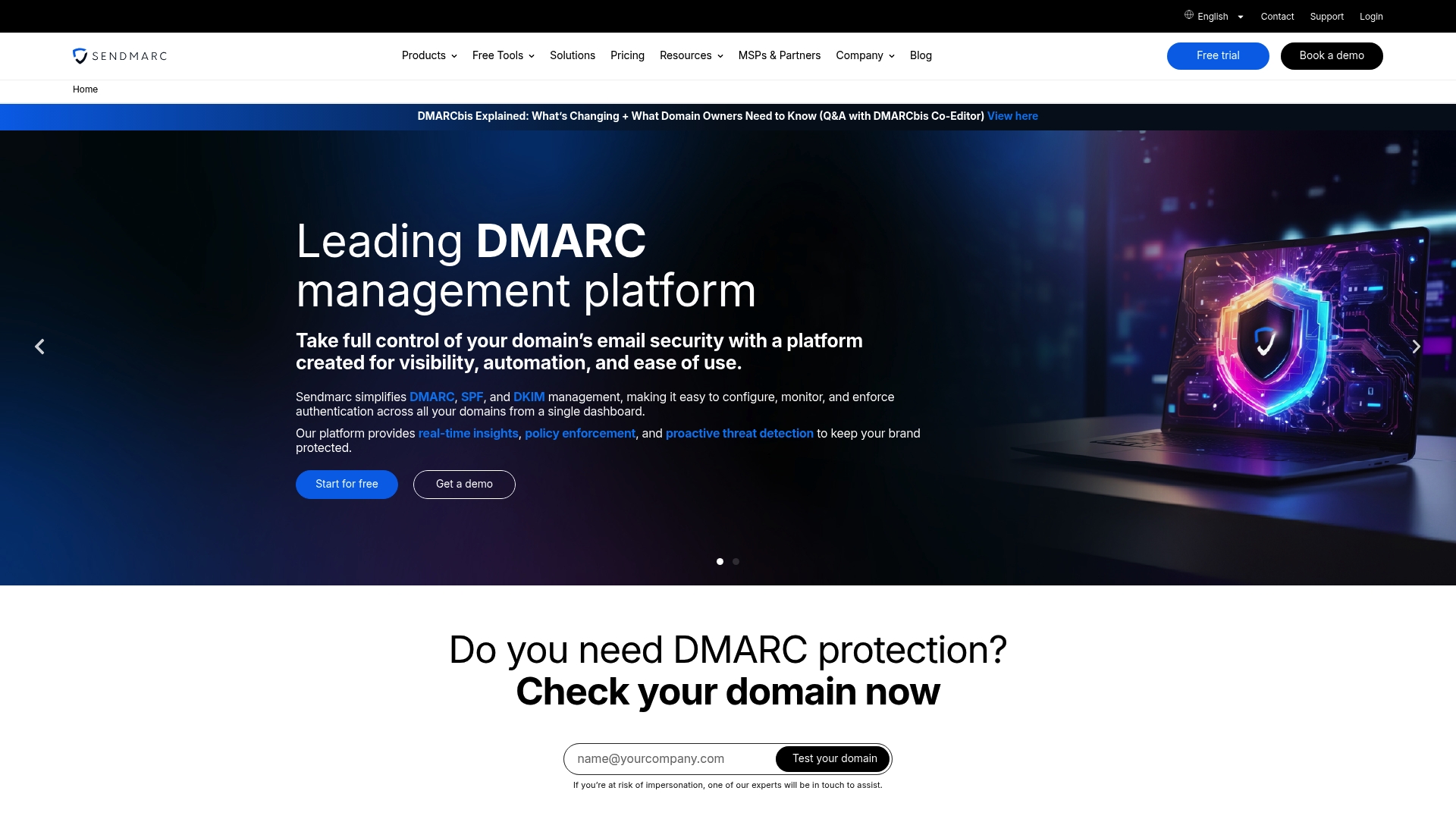
Includes Lookalike Domain Defense to block impersonation using visually similar domains. The platform also monitors for stolen credentials and data with Breach Detection. Organisations can display a verified logo in inboxes via BIMI, which helps recipients spot genuine mail.
Core Features
Sendmarc centralises DMARC, SPF, and DKIM management on a single dashboard and shows who sends mail for each domain. It offers real time insights and threat detection alongside policy enforcement to push domains toward strict authentication. The service adds branding and protection features such as BIMI, lookalike domain defence, and dark web breach monitoring.
Key Differentiator
The product pairs a single control plane with active threat signals so teams see both configuration gaps and live impersonation attempts. That combination helps security teams move from passive reporting to enforced policies while keeping visibility across multiple domains. The unified view speeds triage when suspicious sending patterns appear.
Pros
Sendmarc gives broad visibility into email sources, which helps reduce spoofing and phishing attacks across several brands. The dashboard is user friendly and supports complex environments with many domains and subdomains. Additional protections such as BIMI, lookalike domain defence, and breach monitoring extend basic authentication into brand protection and compromise detection.
Cons
- Initial setup can be complex in large, distributed organisations, requiring coordination with multiple DNS owners.
- DNS change management can create operational delays when rolling out strict policies or publishing DKIM keys.
- Projects sometimes stall because of logo readiness, DNS governance, or internal policy enforcement across teams.
When It May Not Fit
Sendmarc may not suit organisations that lack central DNS control or cannot commit resources to a phased rollout. Small teams with a single domain and minimal DNS bureaucracy may find the onboarding overhead disproportionate. MSPs with limited client access could face delays due to external DNS governance requirements.
Who It’s For
IT security teams, managed service providers, and security professionals responsible for multiple domains will get most value. Organisations focused on both email authentication and brand display will benefit from the BIMI and breach monitoring features. Teams that can coordinate DNS changes across departments will gain the fastest results.
Real World Use Case
A retail chain used Sendmarc to map all email sources across its estate and push DMARC to reject for unauthorised senders. The retailer added BIMI so customers saw a verified logo in inboxes and reported fewer phishing incidents. Breach detection alerted the security team to leaked credentials, which sped account remediation.
Pricing
Not applicable — informational only. Sendmarc does not publish standard pricing in this listing, so procurement typically begins with direct contact for a tailored quote.
Website: https://sendmarc.com
Dmarcian
At a Glance
Founded in 2012 by a primary author of DMARC, Dmarcian brings protocol expertise to domain protection. The vendor reports more than 50,000 domain owners worldwide. Dmarcian pairs tools, deployment services, and education to drive wider DMARC adoption.
Core Features
The platform centres on a DMARC Management Platform that collects and visualises DMARC data to show who sends mail for a domain. Deployment services assist with policy rollout and DNS changes, while dedicated support handles incidents and ongoing configuration. Educational resources and DNS testing tools cover SPF, DKIM, DMARC, BIMI, and source identification.
Key Differentiator
Dmarcian stands out because a primary author of DMARC founded the company, which shapes product design and training. The team participates in industry groups such as M3AAWG and IETF, shaping standards while aligning tools to current practices. That pedigree makes the offering especially suited to organisations seeking protocol-level guidance.
Pros
Deep protocol knowledge informs the service, which helps teams interpret complex DMARC reports and move confidently to reject policies. The combination of deployment assistance and ongoing support reduces the operational burden for in-house engineers. Regional data centres and active involvement in standards bodies support global deployments and compliance with local data rules.
Cons
- External reviews indicate full DMARC implementation can be complex and may require professional assistance.
- Pricing can be a barrier for very small organisations or personal users, especially at enterprise levels.
- The breadth of resources and configuration options may overwhelm teams without dedicated technical expertise.
When It May Not Fit
This service is not a good fit for organisations that lack any DNS or email expertise and cannot budget for professional support. Small projects or hobby domains with minimal email use will probably find the learning curve steep. Organisations that need a plug-and-play, no-configuration scanner will want a simpler dashboard product.
Who It’s For
IT professionals, security teams, and compliance officers who must deploy DMARC and manage domain authentication will benefit most. Managed service providers helping multiple client domains will also find the deployment services useful. Organisations seeking active involvement in standards and protocol guidance will appreciate the expert-led approach.
Real World Use Case
A university used Dmarcian to map all campus subdomains and phase in DMARC policies across multiple mail streams. The deployment services reduced ambiguous sources and clarified which systems required DNS changes. That work led to fewer spoofed messages and clearer trust signals for recipients.
Pricing
Dmarcian offers multiple tiered plans with a free option for personal use and paid plans that scale to enterprise needs. Enterprise solutions use custom pricing and include deployment services and dedicated support. Pricing details for higher tiers are available from sales.
Website: https://dmarcian.com
Skysnag
At a Glance
Skysnag’s marketing materials claim it reduces the time to full DMARC enforcement from months to weeks. It discovers and configures authentication records across many domains and guides policy progression toward p=reject. That approach suits organisations that need fast enforcement across large domain portfolios.
Core Features
Skysnag automates DNS configuration for SPF, DKIM, and DMARC, and offers a single dashboard for unlimited domains. The platform sends real-time spoofing alerts and tracks deliverability, while guided policy progression helps move domains to stronger enforcement. It also includes BIMI verification and brand logo checks for inbox display.
Key Differentiator
Skysnag automates discovery, configuration, and enforcement across large domain portfolios with a guided path to p=reject. That automation reduces manual DNS work and centralises management for teams responsible for many brands or subdomains.
Pros
Automated DNS setup saves time for teams that manage many domains and reduces configuration drift. Real-time threat detection provides instant alerts when spoofing attempts appear, which helps security and support teams respond quickly. Executive-friendly reports and compliance tracking present authentication status clearly for non-technical stakeholders.
Cons
- Some third-party reviews report initial setup and customisation feel complex for first-time administrators.
- Pricing may be expensive for small organisations or for teams with only a few domains.
- Advanced features such as BIMI certification require extra verification steps and vendor coordination.
When It May Not Fit
Skysnag may not suit a small organisation with a single domain and a tight budget. Teams without any DNS know-how will face a learning curve for advanced customisation. If you only need a basic SPF check and no centralised domain management, a lighter tool may be a better fit.
Notable Integrations
Skysnag lists connectors with common marketing, ticketing, and cloud platforms:
- Salesforce
- Active Campaign
- Hubspot
- Zendesk
- Outlook
- Gmail
- AWS
- Oracle
These integrations help feed event data and support ticket workflows for security and marketing teams.
Who It’s For
IT security teams, marketing teams managing brand reputation, and MSPs that operate multiple client domains will gain most from Skysnag. Organisations with numerous domains that need centralised authentication and reporting will find the automation useful. Smaller businesses with limited domains should weigh cost against need.
Real World Use Case
A telecom operator used Skysnag to configure and enforce DMARC across hundreds of domains. The automation cut manual DNS tasks and reduced spoofing incidents. Brand logo verification also improved customer recognition in email clients.
Pricing
Skysnag publishes a plan comparison on its website. Visit the vendor pricing page for exact tiers and features at https://www.skysnag.com/pricing.
Website: https://skysnag.com
yourDMARC
At a Glance
Plans start at $0 to $599.99/month depending on features and domain volume. The platform bundles DMARC, SPF, DKIM checks, DNS tools, and real time threat detection under one dashboard. That mix targets organisations that manage multiple domains and require ongoing monitoring and reporting.
Core Features
yourDMARC runs continuous real time monitoring of email authentication, flags failures, and tracks policy enforcement. It combines compliance management, DNS and record checks, email header analysis, and threat detection into a single interface. The platform scales to handle many domains and offers expert support for configuration and remediation. Dashboards present policy compliance trends and raw reports for forensic analysis.
Key Differentiator
The product’s automation and reporting aim to reduce manual work for administrators managing large domain estates. According to the company, it is trusted by leading brands and automates reporting and threat alerts at scale. This makes it better suited to IT teams running many domains than to organisations wanting a single expert weekly review service. Its automation suits teams that need alerts and reports without a heavy manual process.
Pros
The platform delivers continuous visibility into authentication status, which helps spot spoofing attempts quickly. It includes DNS and record analysis tools that speed configuration and reduce misconfigurations. Users benefit from automated alerts and vendor stated competitive pricing across tiers. Expert support helps teams unfamiliar with DMARC move from monitoring to enforcement. Automated protection reduces time spent chasing false positives.
Cons
- Pricing varies by plan and domain volume, which can become costly for smaller organisations.
- The breadth of tools can overwhelm administrators who prefer a minimal, hands off service.
- Proper setup requires knowledge of email authentication protocols, so internal expertise or consultancy is often necessary.
Who It’s For
IT teams and security operations managing many domains will find the platform fits their workflows. Large organisations, enterprises, and agencies managing client domains will benefit from automated monitoring and reporting. Smaller firms with a single domain may find the complexity and cost excessive. Compliance officers and security leads who must report to regulators will find the reporting useful.
Real World Use Case
A mid size company used yourDMARC to consolidate DMARC, DKIM, and SPF management across multiple subsidiaries. The team reduced authentication failures by tracking policy reports and fixing DNS records faster. Automated alerts let administrators respond to phishing attempts before they affected customer communications.
Pricing
Pricing runs from $0 to $599.99/month depending on feature set and domain volume. The vendor offers free tiers and enterprise licences for high domain counts. Exact costs require contacting sales for tailored quotes.
Website: https://yourdmarc.com
Comparison of alternatives
Choosing the right email authentication monitoring solution requires balancing technical capabilities, user-friendliness, support quality, and suitability to an organisation’s needs. Each reviewed platform stands out in specific areas, offering a range of features and benefits.
Support and user interaction
SealedMail stands out by providing human-reviewed weekly reports written in plain language, ensuring accessibility for non-technical staff. This approach adds a personalised level of support for understanding critical email security statuses. Oppositely, PowerDMARC and Sendmarc cater more to organisations with technical expertise by automating DNS tasks and offering real-time monitoring but require a certain skill level for optimum usage.
Management scalability
PowerDMARC edges ahead in the multi-tenant management for its inclusion of white-label capabilities and handling of many client domains. Skysnag complements scalability with automation for onboarding enterprises controlling numerous domains. For smaller setups, such as single domain non-technical organisations, SealedMail ensures the right balance through simplicity and direct communication without additional technical demands.
Best fit
- Organisations that require expert-reviewed, plain-English compliance and security reports for ease of audit and non-technical intervention will benefit from SealedMail.
- Security teams handling enterprise domains at scale requiring automation for DNS task execution and multi-tenant support will prefer PowerDMARC.
- Firms focusing on brand protection with additional features like lookalike domain defence and data breach detection will find Sendmarc.
Our pick
For teams prioritising streamlined compliance reporting combined with expert advice without needing operational technical resources, SealedMail offers exceptional value through its personalised approach. However, entities demanding automation, large-scale management, or advanced configuration features may prefer exploring more feature-dense solutions such as PowerDMARC or Sendmarc.
Organisations seeking robust DMARC monitoring solutions may evaluate the following options based on feature specificity, tailored reporting capabilities, pricing structure, and ease of use.
| Product | Core Feature | Key Differentiator | Pricing | Notable Limitation |
|---|---|---|---|---|
| Sealedmail | Weekly plain English DMARC reports | Expert-reviewed personalised report written in plain terms | £39 per domain per month | Lacks real-time alerts or a live dashboard |
| PowerDMARC | Centralised DMARC monitoring | Built-in MSP programme with white-label options | Price not published | Requires strong DNS management expertise |
| Sendmarc | Real-time insights and BIMI | Active threat detection paired with brand protection | Price not published | Complex initial setup for distributed organisations |
| Dmarcian | DMARC management platform | Founded by a DMARC protocol author for expert guidance | Price not published | Full implementation may require professional assistance |
| Skysnag | Automated DNS setup and alerts | Quick guided enforcement to strict DMARC policies | Visit website for details | Initial setup complexity for new administrators |
| yourDMARC | Continuous real-time monitoring | Comprehensive tools for large-scale domain management | $0–$599.99/month | Complexity may overwhelm administrators with minimal needs |
Why Understanding Email Security Checker Alternatives Matters for Your Business
Email spoofing and unauthorised senders put many UK organisations at risk, especially law firms, financial services, healthcare, accountants, and charities. The article highlights the challenge of interpreting complex DMARC data and managing DNS updates without technical jargon or specialised skills. For small teams lacking in-house DNS expertise, this complexity can delay actions needed to protect domains from fraud.
Sealedmail offers a clear solution by delivering weekly plain English DMARC reports reviewed personally by a UK expert. This service pinpoints who is sending email on your behalf and explains necessary DNS changes, reducing confusion and easing audit compliance. At £39 per domain each month, businesses receive tailored insights that shift the burden from technical teams to a dedicated specialist.
Discover how Sealedmail provides straightforward email security monitoring for your organisation. Learn more about their personalised approach, and request your first report to see clear, actionable findings within a week.
FAQ
What unique features does SealedMail offer for DMARC reporting?
SealedMail provides personalised DMARC reports that are human-reviewed, making them accessible and easy to understand. Each weekly report highlights spoofing incidents, unauthorised senders, and authentication health, which helps non-technical staff act on the information effectively.
How does SealedMail compare to PowerDMARC in terms of functionality?
PowerDMARC features a built-in multi-tenant MSP partner programme with automation tools, which allows MSPs to manage multiple domains from one console effectively. In contrast, SealedMail focuses on providing straightforward, human-reviewed weekly reports that are ideal for smaller organisations without in-house technical expertise.
Can SealedMail support multiple domains for businesses?
Yes, SealedMail charges £39 per domain per month, making it feasible for small firms to manage email security compliance effectively. This pricing allows multiple domains to benefit from professional oversight without extensive internal resources.
What challenges might users face with SealedMail’s service?
While SealedMail provides valuable reports, it does not offer real-time alerts or a live dashboard, which some organisations might find limiting for immediate response to threats. Users should consider their need for timely updates when deciding on email security solutions.
How does the cost of SealedMail compare to that of other platforms?
SealedMail’s pricing starts at £39 per domain per month, which is competitively low, especially considering it includes personalised reports. This makes it an attractive option for law firms and accountants needing regular audit evidence without incurring high costs.
Recommended

Founder of SealedMail and a UK email-security specialist in DMARC, SPF, DKIM and email authentication for regulated sectors. He personally reads the DMARC and TLS reports behind every SealedMail account and writes the company's plain-English guides. More from Shaun Cooke →
