
Top 4 Email Header Analyzer Alternatives 2026


Choosing a DMARC monitoring platform that actually detects spoofing and delivers usable email authentication reports is harder than most security teams expect. Most email header analysers depend on automated dashboards and machine reporting, which means ambiguous compliance data and patchy audit evidence. This comparison explains report clarity, managed service, enforcement speed, and audit support across four leading alternatives so security teams can pick the tool that matches their expertise and regulatory demands.
Table of Contents
SealedMail
At a Glance
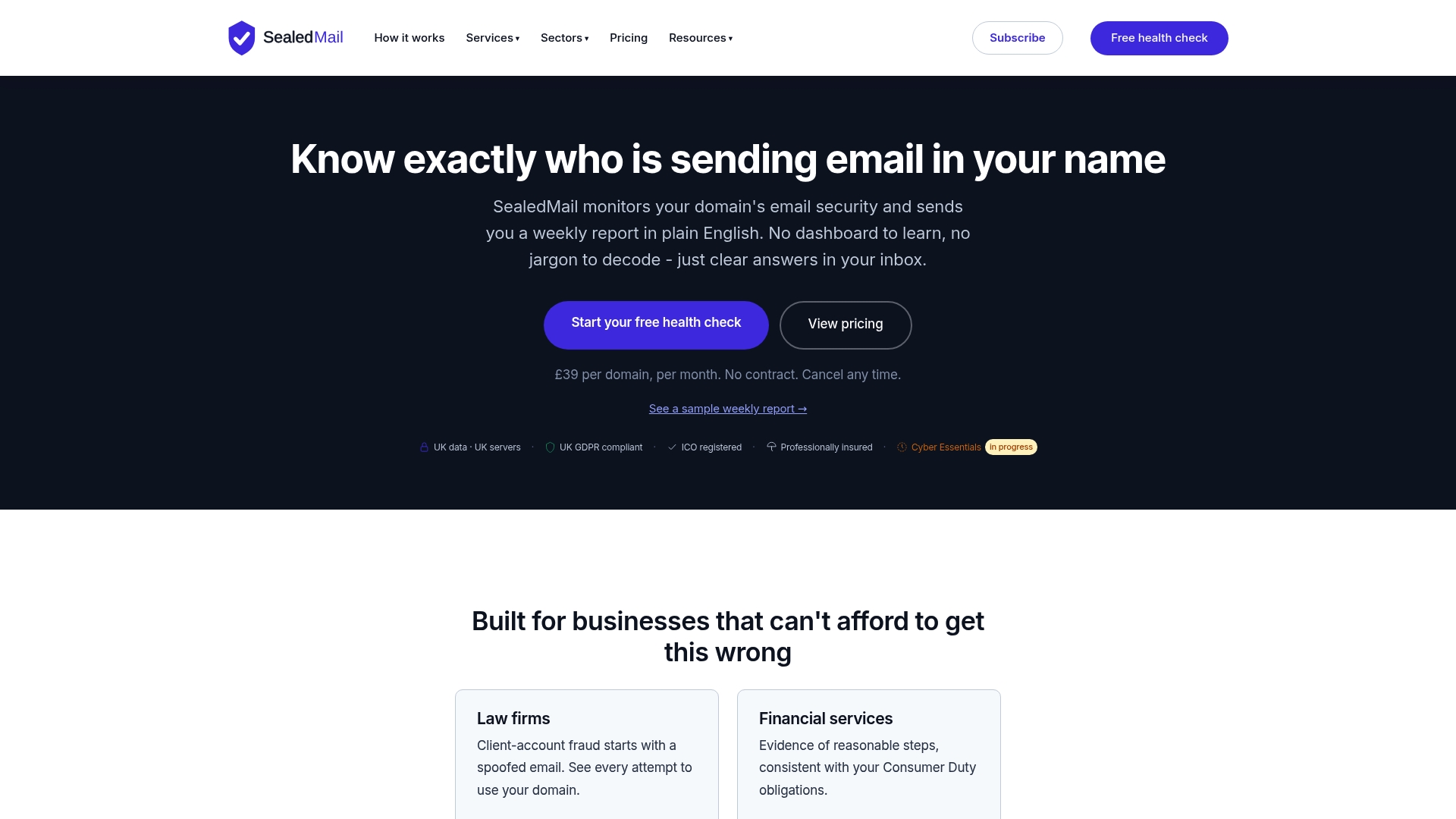
A named UK specialist, Shaun Cooke, personally reviews your DMARC data and sends a weekly plain English report. The service monitors spoofing and unauthorised senders for domains used by UK organisations. Reports aim to provide audit ready evidence without any software installation.
Core Features
SealedMail issues a weekly plain English DMARC report by email and flags spoofing or unauthorised senders. The service checks full authentication health including SPF, DKIM, DMARC, and MTA-STS and hosts an always live DNS status page. Domains are handled under a two tier subscription model that separates active and parked domains.
Key Differentiator
A single, named UK email security specialist personally inspects and interprets your DMARC data before sending the weekly report. That human review sits alongside UK data hosting and a focus on UK regulatory standards such as GDPR and related DNS standards.
Pros
Personal management by a UK expert reduces ambiguous machine reports and makes audit preparation straightforward. Weekly reports are written in plain English and aim to be immediately usable for compliance or board reporting. The subscription model has no contract and requires only simple DNS changes by your IT team or provider, so there is no software to install or staff training to run.
Cons
- No real time alerts or live dashboard for immediate incident response
Who It’s For
UK organisations that send email from their own domains and need straightforward, ongoing monitoring and compliance evidence. Typical sectors include law firms, financial services, healthcare providers, accountants, and charities. The service suits team that prefer an expert to interpret DMARC rather than running in house tooling.
Unique Value Proposition
At £39 per domain per month for active domains, SealedMail offers fixed, predictable billing and human reviewed weekly reports that replace a DIY approach. That price point and the named expert review reduce the need for in house DMARC expertise while producing evidence suitable for audits and regulatory checks.
Real World Use Case
A law firm subscribes to receive weekly explanations of which services send mail on its behalf. The partner responsible for compliance forwards the plain English report to auditors and instructs the IT provider to apply small DNS updates. The firm gains documented proof of ongoing email authentication checks.
Website: https://sealedmail.co.uk
PowerDMARC
At a Glance
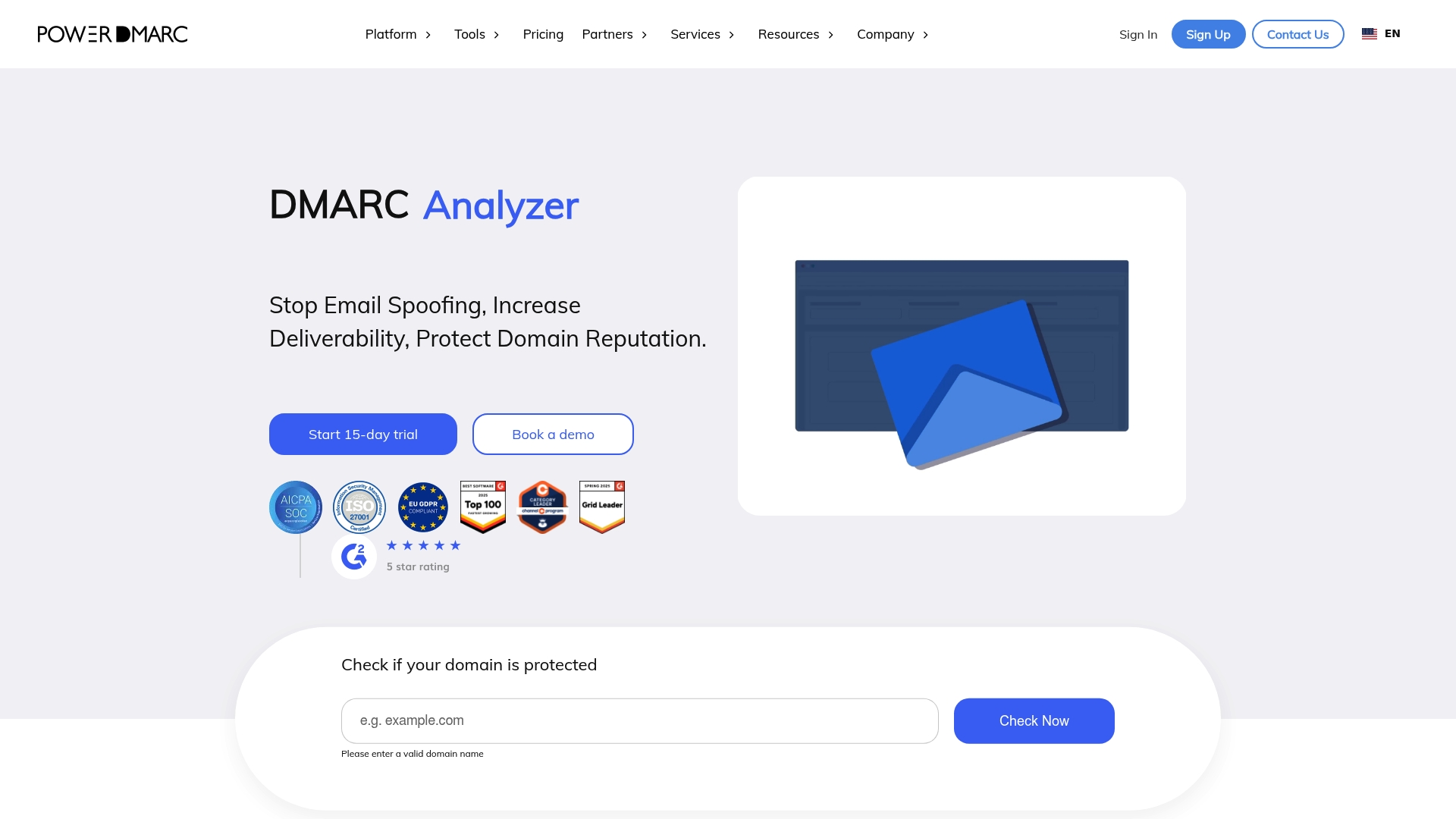
Built-in threat intelligence and a global threat map with AI-driven predictive analytics spot emerging spoofing campaigns before they widen. The platform pairs real-time alerts with detailed DMARC aggregate and forensic reports. This combination helps security teams act on threats and measure domain reputation over time.
Core Features
PowerDMARC centralises DMARC analysis, monitoring, and enforcement while offering automated DNS record publishing and tools for SPF, DKIM, BIMI, and MTA-STS management. A self-service dashboard supports multiple domains and provides security score tracking and live threat visualisation. The control panel is multilingual and includes a partner programme for white label resellers.
Key Differentiator
The vendor emphasises the built-in threat intelligence and global threat map as the standout capability. That integration links forensic reports to geolocated threat data and predictive signals. Teams receive contextual alerts that prioritise high-risk incidents for faster remediation.
Pros
The vendor advertises that PowerDMARC is trusted by Fortune 100 companies, universities, and government agencies worldwide. Automated DNS publishing reduces manual errors and cuts the time needed to publish SPF and DKIM records. The platform supports a white label partner programme, which appeals to MSPs and MSSPs wanting to resell email authentication services. A multilingual control panel and centralised domain management suit organisations with global operations.
Cons
- The platform has a learning curve; extensive features can overwhelm smaller teams.
- Advanced configurations require technical expertise, which may mean outside support for some organisations.
- Organisations using uncommon DNS providers may face additional configuration work.
When It May Not Fit
Small organisations without a dedicated security resource may find the feature set disproportionate to their needs. Teams that prefer a fully managed, hands-off supplier should compare managed service offerings first. Organisations needing immediate DNS changes should account for DNS propagation delays that affect enforcement timing.
Who It’s For
PowerDMARC suits security teams at large organisations, MSPs, and MSSPs managing many domains. It fits buyers who want tight control over authentication records and who can act on forensic alerts. Resellers seeking white label DMARC services will find the partner programme useful.
Real World Use Case
A Fortune 100 company implemented multi-domain DMARC enforcement with PowerDMARC to reduce spoofing incidents and to improve deliverability across international business units. The team used threat maps to pinpoint persistent spoofing sources and adjusted policies by domain. That deployment shows how centralised reporting speeds policy rollout and incident response.
Pricing
Pricing is not publicly listed; contact the vendor for tailored pricing details and quotes. The company offers partner and MSP programmes that may affect pricing and contract terms. Budget conversations should include DNS management and any managed service support you require.
Website: https://powerdmarc.com
Sendmarc
At a Glance
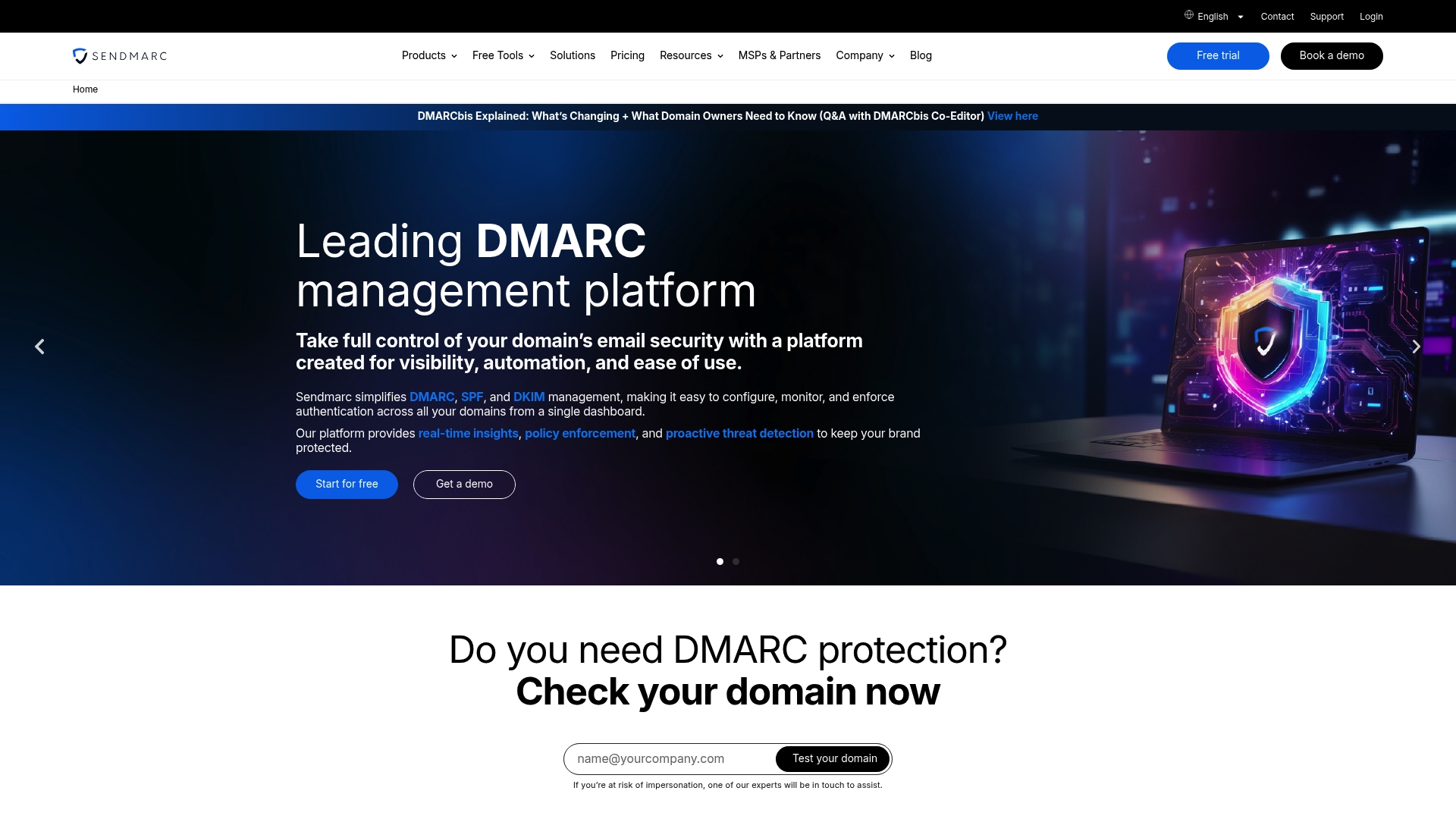
Pairs DMARC enforcement with brand visibility via BIMI and dedicated lookalike domain defence to protect mail flows and reputation. The platform also claims real time threat detection and breach monitoring for distributed email environments. That mix suits organisations that run many domains and need central control.
Core Features
Sendmarc offers a centralised dashboard for DMARC, SPF, and DKIM management alongside automated policy enforcement and monitoring. The service includes real time email security insights, breach detection, and features to display brand logos in compatible inboxes through BIMI. A multi tenant model supports MSPs and partners while APIs and automation help with integrations and managed services.
Key Differentiator
The platform positions itself as an all in one option that links domain authentication with brand visibility and threat detection. That single ecosystem reduces the need to stitch separate tools for enforcement and spoofing defence. The approach aims to keep brand protection and policy enforcement visible in one place for teams managing many domains.
Pros
Customer references in the vendor materials emphasise enterprise and public sector adoption and the platform advertises award recognition for its security tooling. The interface groups reporting, enforcement, and threat alerts so teams can prioritise action without switching screens. Strong partner and MSP programmes mean resellers can manage numerous client domains from a multi tenant view.
Cons
- Complex initial setup that third party reviews say can slow rollout. This is most visible during the enforcement phase.
- DNS updates may not fully automate in large or tightly governed estates. That increases manual work for DNS owners.
- Advanced features such as BIMI and lookalike domain defence have a steep learning curve for teams new to those standards.
When It May Not Fit
Organisations with minimal internal DNS control will find parts of the platform hard to use. Small teams with one or two domains may not need the multi tenant capabilities. Highly regulated bodies that restrict DNS changes could face delays when trying to move to full enforcement. Labs or pilot projects that need an out of the box, zero configuration solution will likely prefer simpler tools.
Who It’s For
Sendmarc suits enterprise security teams, MSPs managing multiple client domains, and organisations that must protect brand reputation across many mail streams. It fits teams that can dedicate DNS and operational resources to a full implementation. The product targets groups that need centralised visibility rather than single domain, ad hoc checks.
Real World Use Case
A retail group used Sendmarc to centralise DMARC reporting and to enforce a reject policy across its domains. The team monitored lookalike domain reports and blocked impersonation attempts while rolling out BIMI for brand recognition. That work reduced the noise from spoofed messages and improved recipient trust in transactional mail.
Pricing
Pricing is not listed publicly by the vendor and appears to be tailored to enterprise and MSP customers. Commercial plans and partner arrangements are available on request. Contact Sendmarc sales for a quote that matches domain count and managed services needs.
Website: https://sendmarc.com
Skysnag
At a Glance
Skysnag reports support for over 10,000 domains, a figure the vendor cites as evidence of scale. The service automates DNS record discovery and populates SPF, DKIM, and DMARC entries. It also offers BIMI certification to show verified brand logos in inboxes and improve recognition. Organisations get a central dashboard for enforcement and threat alerts.
Core Features
Skysnag automates discovery and configuration of email authentication records and centralises management across many domains. The vendor claims rapid DMARC enforcement up to 7x faster than the industry average, which shortens the exposure window to spoofing. The platform includes real-time spoofing detection, automated reputation and blacklist protection, and BIMI certification for verified logos. Reporting and executive dashboards combine compliance, enforcement, and threat analytics.
Key Differentiator
Skysnag positions its standout feature as automated, zero-disruption enforcement of email authentication and domain settings. That claim ties automation to faster policy enforcement and fewer manual DNS errors. The combination of enforcement speed and integrated BIMI services separates it from single-feature tools.
Pros
Automation reduces time spent on DNS edits and lowers human error when implementing SPF, DKIM, and DMARC. Centralised control supports large portfolios and makes coordinated enforcement across many domains practical. Real-time spoofing alerts and blacklist protection limit impersonation risk. Reporting and dashboards provide readable views for security and deliverability teams, and the BIMI pathway helps marketing show verified logos in recipients inboxes.
Cons
- Limited visibility into non-DNS-based email threats. This product focuses on authentication records and will not detect every attack vector.
- Potentially high cost for very large domain portfolios or small organisations. Pricing details are not listed in the product data.
- Some advanced features are complex and may require dedicated training or in-house expertise to operate effectively.
When It May Not Fit
Organisations that cannot provide initial DNS access or lack internal permissions may struggle with setup. Very large operations might need extra custom integrations or vendor support for bespoke workflows. Teams that need detection for non-DNS email threats should pair Skysnag with other specialised tools.
Notable Integrations
- Salesforce
- Gmail
- Outlook
- Amazon Web Services
- Oracle Cloud
- Sendgrid
- Mailchimp
- Hubspot
Who It’s For
Security teams, email deliverability managers, and MSPs managing many client domains will gain most from Skysnag. Marketing teams seeking BIMI certification for brand recognition also find value. Organisations aiming to speed policy enforcement across portfolios will benefit from the automation.
Real World Use Case
A multinational corporation used Skysnag to auto-discover and configure authentication records for its global domains. The company reached full enforcement across its estate within weeks and reduced spoofing incidents. The organisation also deployed BIMI to display verified logos and improve recipient trust.
Pricing
The product data lists pricing as Not applicable — informational only. No public pricing tiers or starting figures are given in the supplied information. Prospective buyers should contact the vendor for current commercial terms.
Website: https://skysnag.com
Comparison of alternatives
For organisations based in the UK seeking streamlined monitoring of email authentication policies with tailored human oversight, multiple options present significant value. Each service analysed here offers a unique approach to DMARC monitoring and enforcement.
Human review versus automated efficiency
SealedMail distinguishes itself with a single named UK email security specialist who manually reviews DMARC data weekly, providing comprehensible summaries that align with UK regulatory demands. This approach is for organisations requiring audit-ready documentation without needing to invest in internal expertise. In contrast, automated solutions like Skysnag excel in rapidly implementing DMARC policies, achieving full enforcement up to seven times faster than average due to its automation capabilities. For organisations managing extensive global domains, this provides an attractive time-saving alternative to individual analysis and setup.
Centralised control and additional features
Businesses managing large domain portfolios or requiring integrated security features may consider PowerDMARC or Sendmarc as potential options. PowedDMARC’s integrated real-time threat alerts and extensive forensic analytics deliver domain oversight, appealing to security-sensitive operations spanning multiple regions. Meanwhile, Sendmarc facilitates enforcement for entities prioritising brand integrity through unique features such as lookalike domain detection and response. Both platforms cater to large-scale, feature-rich requirements beyond email authentication.
Best fit
- UK-based organisations looking for DMARC oversight combined with local compliance expertise can derive benefit from SealedMail’s expert-reviewed reports and straightforward, fixed-cost pricing.
- Large enterprises requiring multinational security capabilities, including live threat alerts and multilingual support, should consider PowerDMARC for its, data-intensive threat tracking solutions.
- Global organisations and MSPs requiring rapid, efficient authentication record implementation and automation across extensive domain portfolios might explore Skysnag.
- Teams implementing advanced branding measures like BIMI while protecting multiple domain email identities should evaluate Sendmarc for its integrated ecosystem supporting such initiatives.
Our pick
For organisations focusing on straightforward, reliable, and regulation-conscious DMARC monitoring in the UK, SealedMail.co.uk is the preferred solution. It uniquely offers services tailored to UK compliance frameworks, with human-reviewed weekly reporting. However, global enterprises or teams prioritising rapid DMARC policy enforcement across vast domain portfolios may find the advanced automation features of competitors like Skysnag more suitable for their needs.
Choosing the optimal DMARC monitoring software relies on understanding their core advantages and special features.
| Product | Key Differentiator | Best For | Pricing | Notable Limitation |
|---|---|---|---|---|
| Sealedmail | Human-reviewed weekly plain English reports | UK organisations prioritising compliance | £39 per domain per month | No real-time alerts or live dashboard |
| PowerDMARC | AI-driven threat intelligence and global threat map | Large organisations and MSPs | Price not published | May overwhelm small teams due to advanced feature set |
| Sendmarc | Brand visibility services with DMARC enforcement | Large enterprises and MSPs | Price not published | Complex initial setup slowing rollout |
| Skysnag | Automated and rapid DMARC enforcement | Organisations with numerous domains | Price not published | Limited detection for non-DNS-based email threats |
Challenges With Email Header Analysis and Clear Solutions
Email header analysis is essential for spotting spoofing and unauthorised senders, but complex reports can leave security teams unsure of what steps to take next. Many organisations, including law firms and financial services, need clear, expert interpretation of their DMARC data without the noise of overwhelming technical detail. Sealedmail resolves this by providing a weekly report personally reviewed by a UK specialist in plain English. This approach ensures clients understand exactly which services use their domains, enabling compliance with regulations and stronger fraud defence.
Sealedmail specialises in ongoing monitoring for UK organisations that send email from their own domains. For £39 per domain per month, the service removes guesswork and offers a straightforward view of your email authentication status, with no software installation or complicated dashboards.
Explore Sealedmail’s service and see how a simple weekly breakdown makes a real difference in email security. Stay informed about your domain’s email activity and take steps confidently with expert support and clear reporting.
FAQ
How does SealedMail support email authentication monitoring?
SealedMail provides weekly plain English DMARC reports that detail spoofing and unauthorised senders. The service checks full authentication health including SPF, DKIM, and DMARC, making it ideal for organisations needing straightforward compliance evidence. This allows users to maintain clear visibility over their email security metrics.
What is the difference between PowerDMARC and SealedMail?
PowerDMARC features built-in threat intelligence and a global threat map with AI-driven predictive analytics that identify emerging spoofing campaigns. SealedMail, on the other hand, fits those needing simpler reporting without the complexity of real-time alerts or dashboards. Consider your organisation’s specific needs when choosing between the two solutions.
Can I use SealedMail for parked domains?
SealedMail operates on a two-tier subscription model that categorises active and parked domains for monitoring. This makes it suitable for organisations that prefer a clear distinction in handling their email security. Be prepared to manage DNS changes effectively through your IT team or provider.
Which platform offers automated DNS publishing?
PowerDMARC provides automated DNS record publishing to reduce manual errors when publishing SPF and DKIM records. While SealedMail does not include this feature, it simplifies compliance with weekly reports tailored to UK organisations. Determine what level of automation your team requires when choosing a service.
How frequently does SealedMail send reports?
SealedMail sends weekly plain English DMARC reports that highlight spoofing incidents and unauthorised senders. This recurring format ensures that organisations receive timely insights for their email security compliance measures. Regular updates make it easier for teams to prepare for audits effectively.

Founder of SealedMail and a UK email-security specialist in DMARC, SPF, DKIM and email authentication for regulated sectors. He personally reads the DMARC and TLS reports behind every SealedMail account and writes the company's plain-English guides. More from Shaun Cooke →
