
Domain reputation: what UK organisations need to know

TL;DR:Domain reputation is a trust score based on email authentication, sending behavior, and complaint history. It determines whether your emails reach the inbox or end up in spam, especially crucial for Welsh organizations handling sensitive information. Regular audits, proper authentication setup, and progressing DMARC policies are vital to maintaining a strong, durable reputation and avoiding spoofing threats.
Domain reputation is the trust score that mailbox providers and anti-spam services assign to your domain, based on your email authentication records, sending behaviour, and complaint history. A strong reputation means your emails reach the inbox. A poor one means they land in spam, or get blocked entirely. For Welsh businesses and organisations handling sensitive communications, whether in law, finance, healthcare, or the third sector, protecting that trust is not optional. It is the foundation of every email your domain sends.
What is domain reputation and why does it matter?
Domain reputation is the industry term for what many also call “sender reputation” or “domain trust.” Mailbox providers such as Google and Microsoft evaluate it every time an email leaves your domain. The score they assign determines whether your message reaches a recipient’s inbox or disappears into a junk folder.

Domain-based authentication is now more critical than IP reputation. That shift matters because it ties your reputation to your domain identity, not to a specific server or hosting provider. You can change your infrastructure without losing the trust you have built, provided your authentication records remain intact.
Three standards form the backbone of domain reputation: SPF (Sender Policy Framework), DKIM (DomainKeys Identified Mail), and DMARC (Domain-based Message Authentication, Reporting and Conformance). SPF lists the servers permitted to send on your behalf. DKIM adds a cryptographic signature to each message. DMARC tells receiving servers what to do when a message fails those checks. Together, they are the engine behind most email fraud prevention.
The NCSC’s Active Cyber Defence programme demonstrated this at scale. DMARC enforcement across central government reached 100% by 2022, blocking millions of spoofed emails every month. That result shows what full authentication enforcement achieves in practice.
How to check your domain reputation
Assessing your domain’s reputation requires checking several layers, not just one tool or metric. Start with your authentication records.
Authentication record checks:
- Verify your SPF record is published and correctly lists all authorised sending sources.
- Confirm DKIM keys are active and use at least 2,048-bit encryption.
- Check your DMARC policy is published at the correct subdomain (
_dmarc.yourdomain.com) and set to at leastp=noneto begin collecting reports.
Beyond authentication, check whether your domain appears on any major blocklists. Services such as MXToolbox allow you to query dozens of blocklists simultaneously. A listing on even one major blocklist can suppress delivery across entire mail networks.
Monitoring frequency matters. Weekly audits of reputation metrics can prevent delivery problems and catch blocklist risks early. Experts recommend spending around ten minutes each week reviewing blacklist status, DMARC aggregate reports, and sending performance data. That small investment prevents large problems.
One significant change affects Welsh organisations that previously relied on the NCSC’s Mail Check service. The NCSC retired Mail Check on 31 March 2026, ending a service that had supported around 17,000 UK organisations. Its retirement removes a key source of spoofing visibility for public sector bodies, charities, and NHS-connected organisations. Those teams now need an alternative DMARC reporting platform to maintain the same level of oversight.
Pro Tip: Run a free domain health check to get an immediate picture of your authentication status and any obvious gaps before you begin a full audit.
What factors influence your domain’s reputation?
Several technical and behavioural factors shape how mailbox providers score your domain. Authentication configuration is the most controllable.
- DMARC policy level. A policy of
p=nonecollects data but blocks nothing. Moving top=quarantineand thenp=rejectprogressively closes the door on spoofed mail. The NCSC recommends moving to p=reject after two to four weeks of monitoring atp=none. - SPF strictness. An SPF record ending in
-all(hard fail) tells receiving servers to reject any message from an unlisted source. A~all(soft fail) is weaker and leaves room for abuse. - DKIM key strength. Keys shorter than 1,024 bits are considered insecure. A 2,048-bit key is the current standard for strong authentication.
- Complaint rate. Maintaining complaint rates below 0.1% and hard bounce rates under 2% is the benchmark for consistent inbox placement. Exceeding either threshold signals poor list hygiene or unwanted mail to mailbox providers.
- Bounce rate. Hard bounces above 2% indicate you are sending to invalid addresses. That damages your reputation quickly and persistently.
- Sending consistency. Sudden spikes in volume, especially from a domain with no prior sending history, trigger spam filters. Mailbox providers expect predictable patterns.
- Engagement signals. Opens, replies, and clicks tell providers that recipients want your mail. Low engagement over time pulls your reputation down even if your authentication is perfect.
Industry benchmarks for 2026 show inbox placement above 95% is achievable with rigorous authentication and good list hygiene. That figure is not aspirational. It is the standard that well-managed domains routinely hit.
How to maintain and improve your domain reputation
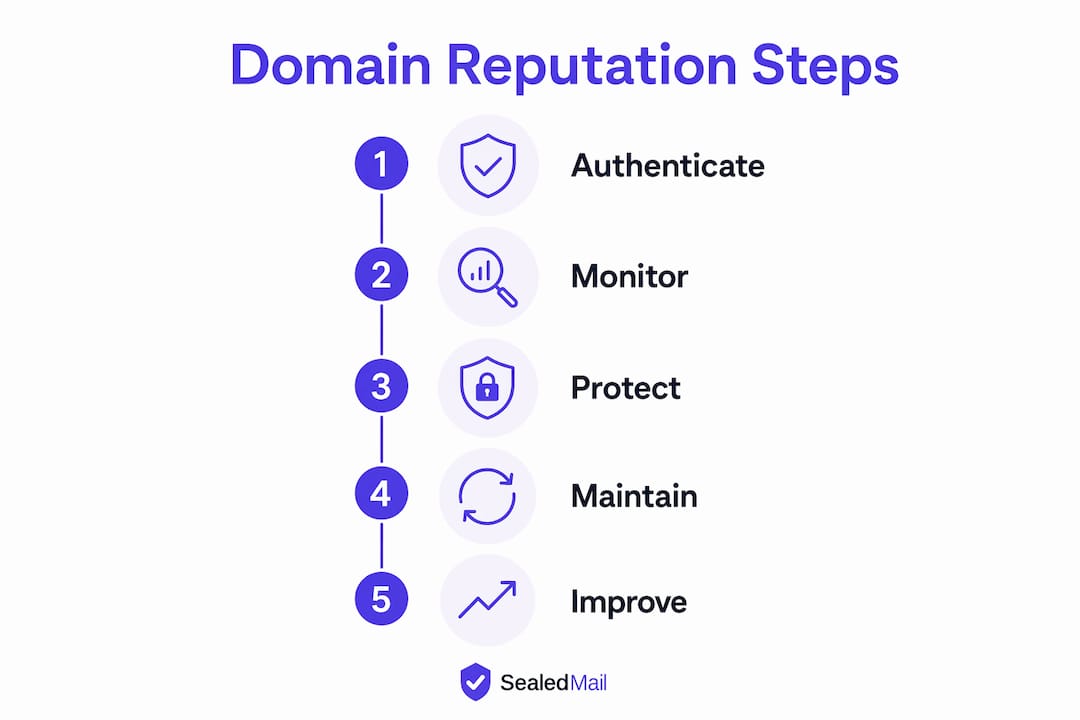
Maintaining a strong reputation requires consistent habits, not one-off fixes. The most effective approach combines regular audits with a disciplined policy progression.
Weekly monitoring routine:
- Review DMARC aggregate reports for any unauthorised sending sources.
- Check your domain against major blocklists.
- Monitor bounce and complaint rates from your email sending platform.
- Confirm no new sending services have been added without updating your SPF record.
Policy progression is equally important. Many organisations publish a DMARC record at p=none and leave it there indefinitely. That collects data but provides no protection. The correct path is to move from p=none to p=quarantine once you have identified all legitimate sending sources, then to p=reject once you are confident the policy will not block genuine mail.
Protecting all domains you own is a step many organisations overlook. Every domain registered to your organisation, including parked domains and legacy domains no longer used for email, needs authentication records. Non-sending domains should carry DMARC at p=reject and an SPF record of v=spf1 -all. Without these, attackers can spoof those domains freely.
Pro Tip: For law firms and financial services organisations, protecting legacy domains is especially urgent. Fraudsters target trusted professional brand names, and an unprotected old domain is an open door.
Secondary domains deserve separate attention. If your organisation runs cold outreach campaigns, using secondary domains warmed over two to four weeks protects your primary domain’s reputation. Starting cold outreach from your main domain risks complaint spikes that can take months to recover from.
Common pitfalls in domain reputation management
The most damaging mistakes in managing domain trust are not technical failures. They are oversights.
Pitfalls to avoid:
- Ignoring parked domains. Attackers actively scan for domains with no DMARC record. A parked domain with no SPF or DMARC is a ready-made spoofing tool.
- Staying at p=none indefinitely. Collecting DMARC reports without acting on them gives a false sense of security. The data is only useful if you use it to progress your policy.
- Cold outreach from your primary domain. Sending high volumes of unsolicited email from your main domain without a warm-up period causes complaint spikes. Those spikes damage the same domain your clients and partners trust for day-to-day communication.
- Losing visibility after tool changes. Organisations that relied solely on NCSC Mail Check now have a gap in their monitoring. Without a replacement platform, spoofed mail can go undetected for weeks.
- Misreading DMARC aggregate reports. Aggregate reports (RUA) show which sources are sending on your behalf and whether they pass authentication. A sudden appearance of an unknown sending source is a red flag that needs immediate investigation.
Consistent monitoring and proactive auditing separate organisations with stable reputations from those facing frequent deliverability crises. The difference is rarely technical sophistication. It is the discipline of checking regularly and acting on what the data shows.
Organisations that treat domain reputation as a set-and-forget configuration will eventually face a spoofing incident or a deliverability collapse. Both are avoidable with the right monitoring in place.
Key takeaways
Domain reputation is determined by authentication configuration, sending behaviour, and consistent monitoring. Organisations that enforce DMARC at p=reject, maintain clean lists, and audit weekly achieve the strongest and most durable inbox placement.
| Point | Details |
|---|---|
| Authentication is the foundation | SPF, DKIM, and DMARC together control who can send on your domain’s behalf. |
| NCSC Mail Check has retired | Organisations must now use an alternative DMARC reporting platform for spoofing visibility. |
| Complaint and bounce thresholds | Keep complaint rates below 0.1% and hard bounces under 2% to protect inbox placement. |
| Protect all domains, not just active ones | Parked and legacy domains need DMARC p=reject and SPF v=spf1 -all to block spoofing. |
| Weekly audits prevent crises | Ten minutes each week reviewing DMARC reports and blocklist status catches problems early. |
Why I think most organisations underestimate this problem
Welsh organisations tend to be pragmatic about technology. If something works, they leave it alone. That instinct is understandable, but it is exactly the wrong approach to domain reputation.
I have seen organisations with excellent client relationships and strong brand names discover, months after the fact, that fraudsters had been sending emails in their name. The spoofed messages looked legitimate. The damage to trust was real. In every case, the organisation had authentication records in place but had never moved beyond p=none. The data was there. Nobody was reading it.
The retirement of NCSC Mail Check in march 2026 made this worse for many public-facing organisations. Teams that had relied on it for years suddenly lost their monitoring window without realising the gap it left. Replacing it is not complicated, but it requires a deliberate decision to act.
My honest view is that domain reputation management is one of the few areas in email security where the gap between “doing something” and “doing it properly” is enormous. Publishing a DMARC record at p=none feels like protection. It is not. Full enforcement, combined with weekly review of aggregate reports, is what actually stops fraud.
For any Welsh organisation handling sensitive communications, whether that is a solicitor’s practice in Cardiff, an NHS-connected body in Swansea, or a charity operating across the valleys, the question is not whether you can afford to monitor your domain reputation properly. It is whether you can afford not to.
— Shaun
How Sealedmail supports your domain reputation
Sealedmail provides DMARC monitoring designed specifically for organisations that want clear answers without technical complexity. Every week, a single expert personally reviews your DMARC data and sends you a plain-English report covering what is happening on your domain, what needs attention, and what to do next. There are no dashboards to interpret and no jargon to decode.
For organisations that lost visibility when NCSC Mail Check retired, Sealedmail offers a direct Mail Check alternative built for the same audience. Coverage starts at £39 per domain per month, with no long-term contract required.
FAQ
What is domain reputation in email security?
Domain reputation is the trust score that mailbox providers assign to your domain based on authentication records, complaint rates, and sending behaviour. It directly determines whether your emails reach the inbox or are filtered as spam.
How do I check my domain reputation?
Check your SPF, DKIM, and DMARC records using a tool such as MXToolbox, then query your domain against major blocklists. A free health check from Sealedmail gives you an immediate assessment of your authentication status.
What DMARC policy gives the best protection?
DMARC at p=reject provides the strongest protection by blocking all unauthenticated mail outright. The NCSC recommends progressing from p=none to p=reject over two to four weeks of monitoring.
Do parked domains need DMARC records?
Yes. Non-sending and parked domains are common spoofing targets. They should carry DMARC at p=reject and an SPF record of v=spf1 -all to prevent fraudsters from using them to send fake emails.
What replaced NCSC Mail Check after its retirement?
The NCSC retired Mail Check on 31 march 2026. Organisations now need a third-party DMARC reporting platform to maintain the same spoofing visibility. Sealedmail’s monitoring service is a direct replacement for organisations previously relying on Mail Check.
Recommended

Founder of SealedMail and a UK email-security specialist in DMARC, SPF, DKIM and email authentication for regulated sectors. He personally reads the DMARC and TLS reports behind every SealedMail account and writes the company's plain-English guides. More from Shaun Cooke →
